



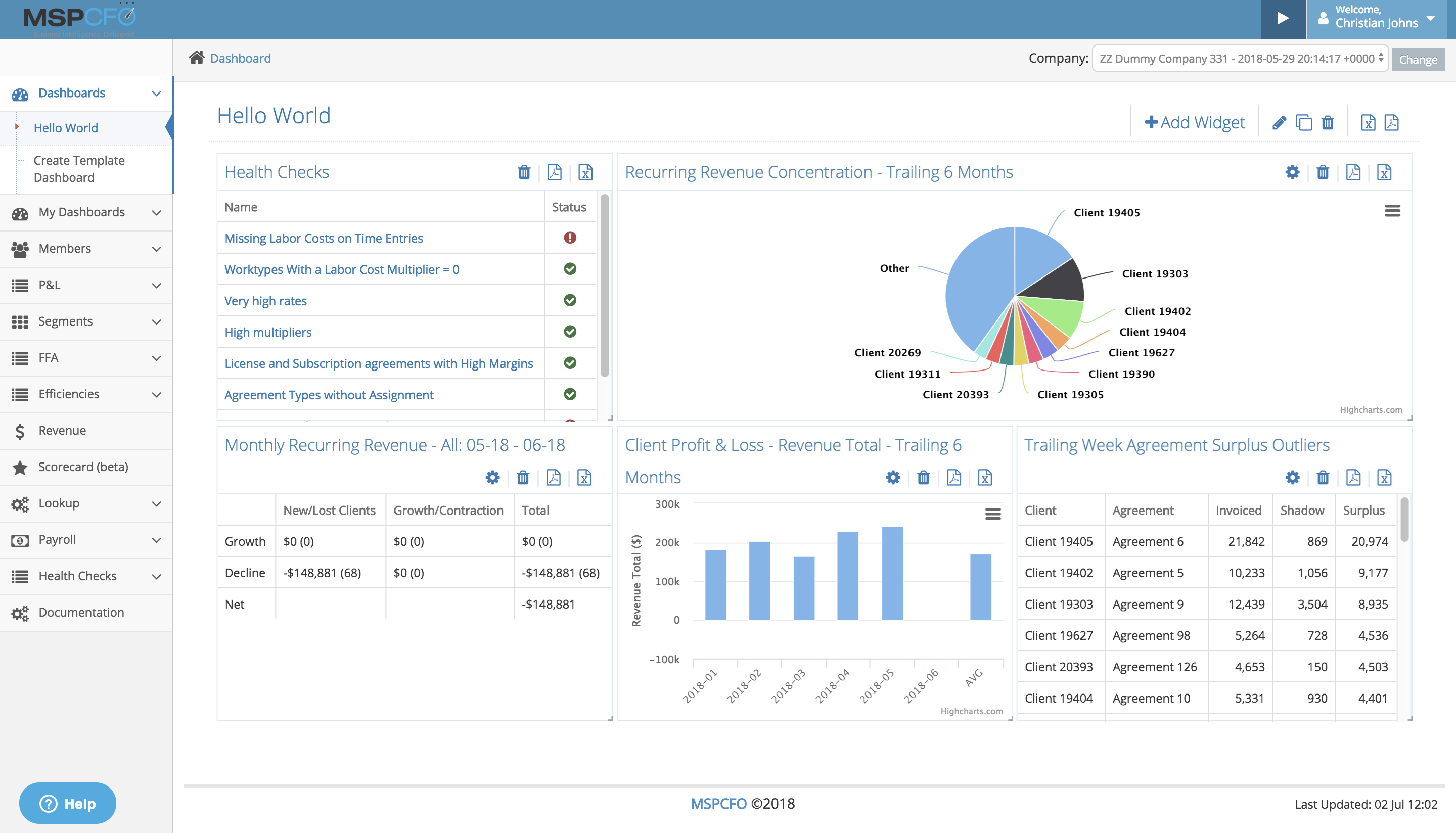
Announcing Feature for Increased Visibility
At MSPCFO, we continually innovate to provide MSPs with the most actionable and accurate reporting they can have to make improvements to their businesses. As

Using Data to Drive Pricing – and Profits
For any MSP, data should drive strategy. It’s not just what the data shows you, but how you use that data, that determines business success.
Are Your Flat Fee Agreements Truly Profitable?
Are your flat-fee agreements as profitable as they could be? In this blog post, we will discuss measuring agreement profitability, and we’ll go over a few

How to Grow Sales: Data and Perspective
Our latest webinar, How to Grow Sales: Data and Perspective, looks at how Managed Service Providers (MSPs) can keep their sales funnels full of warm leads.

Strong Is Weak, Weak Is Strong: What MSPs Get Wrong About Their Own Data
Confident your PSA data is solid? That might be exactly the problem. Larry Cobrin breaks down the poker-player pattern he sees on every discovery call — and why the MSPs most sure their data is clean are often the ones with the biggest blind spots before handing anything to AI.

MSPCFO Announces Native Integration with HaloPSA, Bringing Advanced Financial Reporting to the Halo Community
The integration gives HaloPSA users direct access to 60+ MSP-specific financial reports — powered by the data already living in their PSA.

The Churn Patterns We Didn’t Expect: Findings from Hundreds of MSPs
We took a deep-dive into churn data across hundreds of MSPs — and what we found challenges some common assumptions about which clients are at risk. High-efficiency clients, clients without active project work, and low-revenue accounts all showed elevated churn rates in the aggregate data. Here’s what the patterns reveal, and why it matters for any MSP focused on EBITDA growth.

Observations from GTIA: AI Growth Is Real, but Discipline Wins
AI isn’t the advantage anymore. Everyone has it. What separates firms now is how well they execute, operationalize, and manage the growing complexity across services, pricing, and delivery.
Strong Is Weak, Weak Is Strong: What MSPs Get Wrong About Their Own Data
Confident your PSA data is solid? That might be exactly the problem. Larry Cobrin breaks down the poker-player pattern he sees on every discovery call — and why the MSPs most sure their data is clean are often the ones with the biggest blind spots before handing anything to AI.
MSPCFO Announces Native Integration with HaloPSA, Bringing Advanced Financial Reporting to the Halo Community
The integration gives HaloPSA users direct access to 60+ MSP-specific financial reports — powered by the data already living in their PSA.
The Churn Patterns We Didn’t Expect: Findings from Hundreds of MSPs
We took a deep-dive into churn data across hundreds of MSPs — and what we found challenges some common assumptions about which clients are at risk. High-efficiency clients, clients without active project work, and low-revenue accounts all showed elevated churn rates in the aggregate data. Here’s what the patterns reveal, and why it matters for any MSP focused on EBITDA growth.
Observations from GTIA: AI Growth Is Real, but Discipline Wins
AI isn’t the advantage anymore. Everyone has it. What separates firms now is how well they execute, operationalize, and manage the growing complexity across services, pricing, and delivery.